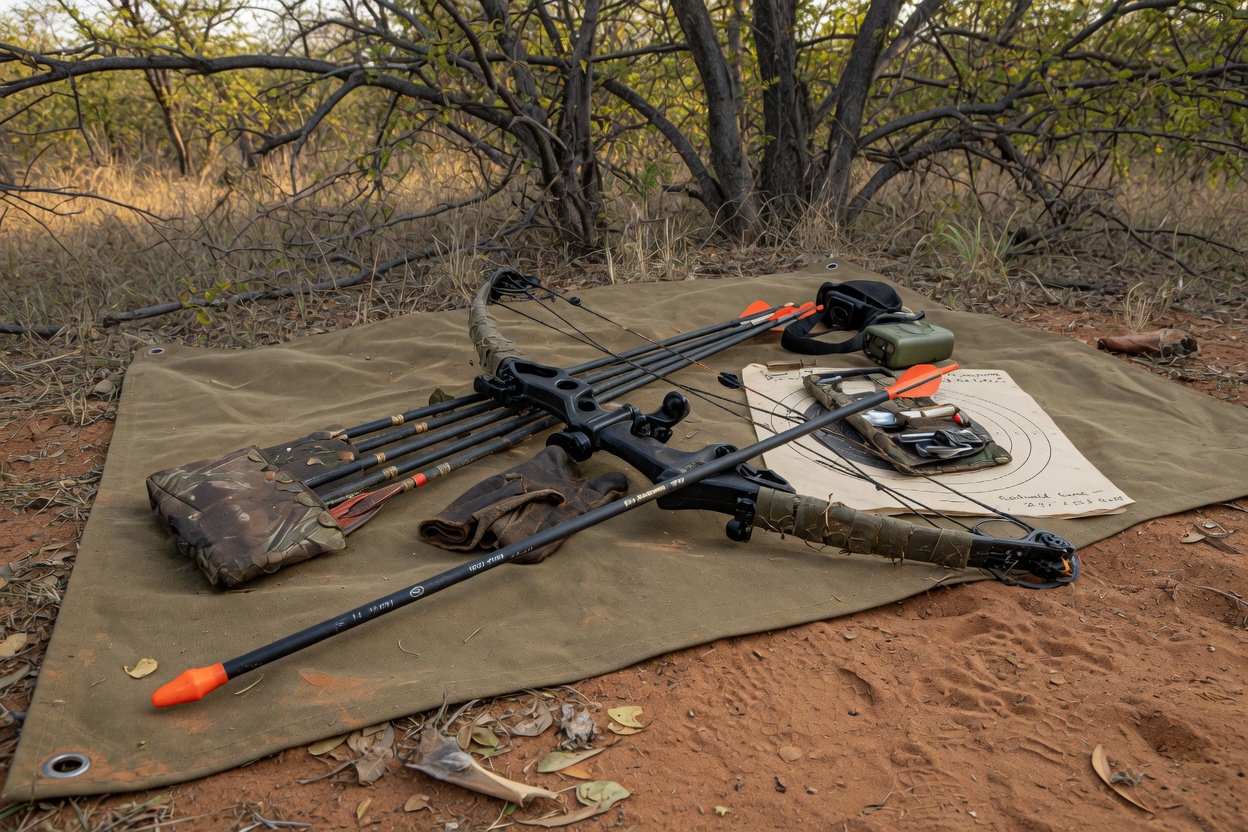
The thick bushveld of southern Africa is a bowhunter's dream and nightmare rolled into one. Dense mopane scrub, tangled acacia, and limited visibility turn every stalk into a test of patience and precision. Shots often come at 15 to 30 yards through narrow windows in the vegetation, demanding a setup that is compact, quiet, and deadly accurate. Get it right and you will experience some of the most intimate and rewarding hunts of your life. Get it wrong and you will spend the day fighting your gear instead of focusing on the game.
I have spent more seasons than I can count hunting impala, kudu, warthog and bushbuck in the Limpopo and Waterberg regions. The lessons I learned the hard way form the backbone of this guide. Modern equipment has made the job easier, but the fundamentals have not changed. Your bow must be short enough to swing through thick cover, quiet enough not to alert animals at close range, and powerful enough to deliver an ethical kill on tough-skinned plains game.
Start with the bow itself. In thick bushveld a long axle-to-axle compound is a liability. Look for a compact design between 28 and 32 inches. These shorter bows thread through branches without catching and allow you to draw from awkward positions, whether you are kneeling behind a termite mound or sitting in a hastily built ground blind. High let-off cams, now commonly 80 to 90 percent on quality hunting bows, let you hold at full draw while an animal picks its way through the last few metres of cover. Draw weights of 60 to 70 pounds are more than adequate for most bushveld species when paired with the right arrow. Heavier is not always better; fatigue from holding a 80-pound bow in 35-degree heat will cost you more animals than extra kinetic energy will gain.
Arrows are where many hunters go wrong. Light, fast arrows that work well in open country simply do not carry enough momentum through thick hide and bone. Aim for a finished arrow weight of 420 to 500 grains. Carbon shafts in the 300 to 340 spine range, depending on your draw length and weight, give you the stiffness needed for broadhead flight while remaining reasonably priced. Front-of-centre balance around 15 to 18 percent helps the arrow fly true even if it clips a twig on the way. I personally favour a slightly heavier setup, around 470 grains, because the extra mass translates into better penetration on quartering shots, which are common when animals are moving through dense vegetation.
Broadhead choice is equally critical. Mechanical heads have improved dramatically in the last five years. Models with rear-deploying blades and solid locking mechanisms now perform reliably even after being dragged through thornbush. That said, many professional hunters I work with still prefer a quality fixed-blade head of 100 to 125 grains for the simple reason that there are no moving parts to fail. Whatever you choose, practice with the exact heads you will hunt with. A broadhead that flies perfectly from your backyard target can plane wildly after a 20-yard shot through mopane leaves.
Accessories must be chosen with snag-proofing in mind. A short 6- to 8-inch stabilizer or even a bare riser is preferable to a long hunting bar that will catch every vine. Limb-mounted dampeners and string silencers are non-negotiable; the last thing you want is a loud twang echoing through the stillness when an animal is 18 yards away. Rests should be quiet and forgiving. A well-tuned drop-away or a quality full-capture rest both work, provided they do not rattle. For sights I recommend a simple three-pin setup or even a single-pin slider set for 20 and 30 yards. In thick bush you will rarely need more. A peep sight with a large aperture helps in the low light of early morning and late afternoon, which is when most bushveld movement occurs.
Your quiver deserves special attention. A bow-mounted quiver looks tidy at the range but becomes a branch magnet in the field. I switched to a lightweight hip quiver years ago and have never looked back. It keeps the bow profile slim and lets me leave extra arrows behind when I need to crawl the last 40 metres. If you prefer a bow quiver, choose one that detaches in seconds and practice the motion until it is second nature.
Tuning cannot be rushed. Paper-tune first, then walk-back tune at the distances you expect to shoot. Once the bow is grouping well, take it into similar vegetation and shoot from kneeling, sitting and even lying positions. Brush will deflect arrows; knowing how much and in which direction is knowledge you can only gain through practice. A quality rangefinder is useful, but do not become dependent on it. In thick cover you often have only seconds to decide whether the shot is ethical. Learn to judge 20 and 25 yards instinctively.
Ethics sit at the heart of every decision. Bushveld hunting is close-range work. That intimacy demands perfect shot placement. The heart-lung area on an impala or young kudu is not large when the animal is quartering away through thorns. If you cannot see a clear path to the vitals, wait. A wounded animal in thick cover is a conservation failure and a personal one. Hunting in these areas supports habitat protection and anti-poaching efforts when done through reputable operators. Choose outfits that contribute to community programs and wildlife management, and you become part of the solution rather than just a visitor.
I still remember a late-afternoon stalk on a mature warthog boar in the Waterberg. The wind was perfect, the cover thick. My compact 30-inch bow let me draw while crouched behind a fallen log. The 460-grain arrow with a fixed-blade head passed through both shoulders at 19 yards. The boar piled up within 30 metres. That hunt succeeded because every piece of gear had been chosen and tested for exactly those conditions.
Your setup will never be finished. New strings, different fletching, a slightly heavier point, all of these small changes add up. Keep a notebook. Record what works and what fails. Share your findings with other hunters. The bushveld rewards those who prepare thoroughly and hunt with respect.
If you are planning your first or fiftieth bushveld bowhunt, start with the principles in this guide and then adapt them to your own style and the specific concession you will hunt. The animals deserve our best effort. So does the wild country that still holds them.